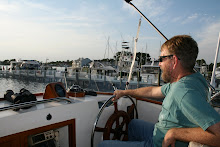
The teaky saloon of the ol' Betty Jane ...the perfect place to blog yer heart out!

A Better Mouse Trap?

I guess I'm as into reading maritime literature as any man alive. I can remember exactly where I was and what I was doing when I read certain salty works like Melville's Moby Dick, Raphael Sabatini's Captain Blood, London's Sea Wolf, and Conrad's Lord Jim. Lots of times I was onboard a vessel of some description at the time, either one I owned or one I was working on, stealing a few hours away from life's routine to go a'yondering, as Louis L'Amour (who wrote more than a few yarns of the sea) once described the practice of simply going someplace, whether in physical reality or a properly imagined one, for no particular reason other than to see what you might see. Heck, I remember reading my first Clive Cussler ditty (Raise The Titanic) by candle light on an old Seabird yawl I owned for a while. I was tied up at a rough-and-tumble marina in Indian Rocks Beach, Florida. Right on the edge of the ICW. I can almost feel the pages today and smell the perfume of outboard-motor (for docking purposes), mildew, brackish water, and melted wax.

So, considering how smitten I've always been with the pure, tactile romance of books and reading, would you ever think I'd buy a freakin ' electronic book? Well, let's just say the part of me that digs technology prevailed upon the romantic part and here I am with am Amazon Kindle in my hands.

And I gotta say--what a wonderful device. Recently, I decided to re-read Robert Louis Stevenson's Treasure Island and, while laying in the V-berth of the Betty Jane, on the spur of the moment, I downloaded (it took about a minute) not only Treasure Island but all of Stevenson's works for about $5 and began reading right away. Books for sale on Kindle are both fast and CHEAP!!!!!!!!!

Moreover, when I used to travel to do boat tests in the pre-Kindle days, I typically carried along a few inspirational books that I regularly enjoy reading each morning. Only trouble was the darn things had a tendency to weigh me down whilst I pulled my roller through airports en route to the tests.

But guess what! Just about all of these books are in the Kindle library so I've downloaded what I could and substituted a couple of others. So these days, instead of packing a passel of physical books around with me, I just drop the Kindle into the Filson computer bag I've been carrying to tests for about 15 years now and I'm good to go. Figure I save myself about five pounds of extra weight.

By the way. If you buy a Kindle of your own, remember to also buy a slip-on sock to protect it from wear. I got one that matches my Filson and is padded for extra protection. As I recall, I bought it off the Kindle website.

The (Actual) Great Beautification

Well, as you may have guessed from the photo here, the plans for the Great Beautification had to be changed slightly. I went to work with the ensemble of products mentioned in previous entries and the result was none to spiffy.

The main problem? As usual, tackling the job with a hint of know-it-all arrogance. I mean, how difficult could it be to develop a wondrous sheen with a buffer, a little rubbing compound (of the exceptionally mild variety) and a little wax. And aren't the pages and pages of advice on detailing available on the internet enough to help a guy transform a scruffy boat (or only slightly scruffy boat, in Betty's case) into a veritable show piece?

Hmmmmm. Well, lemme tellya...detailing ain't exactly easy, even after watching a whole pile of internet clips purporting to offer the inside track. Hey! Although the little devils look much the same, there's a major difference between operating a power grinder (as I used to do while working as a deckhand on commercial steel boats in my younger days) and operating a power buffer or polisher. And also, detailing boats and cars are two largely different tasks as well. The six-inch Porter-Cable polisher I started out with was not nearly as effective as the Porter-Cable nine-incher I wound up using.
To read what I specifically did to produce a knock-down-drag-out finish on Betty Jane please refer to the upcoming portion of the Shipyard column in the June issue of Power & Motoryacht magazine--it's entitled Wax On, Wax Off. In the pieced, you'll notice I had to change my wax slightly (check out the above photo to see what I substituted for Collinite's paste wax) and I also had to skip the Finess-It II. Ah well!

In case you're interested in what's going on in the photo here, it's pretty simple. I am removing dried rubbing compound from a polishing pad with a tool created for the purpose. You gotta do this ever so often to keep the pad working well. Actually, a screw driver works just as well as the tool shown here and, if you've got a few spares kickin' around that aren't gonna cost anything, is a heck of a lot cheaper.

The Start Of The Great Beautification II

Boring picture, right? Well, not exactly. At least for a guy like me who's a hard-bitten do-it-yourselfer and has been since birth.

As noted in a previous post (The Start Of The Great Beautification), I have decided to hit the ol' Betty Jane with the ultimate wax job, an extravaganza propounded by my friend Milt Baker, the proud owner of a Grand Banks 32 who's now switched over to a Nordhavn passagemaker. In a missive to the Grand Banks web site some while ago Milt spent some words on a relatively simple, yet succinct, method for achieving a very high level of cosmetic finish on a fiberglass boat. He seemed pretty confident of the system he'd fallen upon and the products that put the pizazzzzzzzz in it.

So anyway, having taken a tip from Milt, I have now assembled most of the tools and products I need for the job. These include a 5-inch buffing plate and a bunch of six-inch foam-wool buffing pads (shown in my hand above), a Porter Cable 7424 orbital polisher/sander (not shown), a pile of green microfiber towels (shown above), a quart of a 3M product called Finess-It , and, for the application of the primo wax I am going to use--an old-fashioned paste type (No. 885) from the Collinite Company of Utica, New York (not shown)--a six-and-a-half-inch gray-foam finishing pad (it's behind the plate/buffing pad combo in my hand).

Note that I got most of this stuff from Autogeek.net, an excellent outfit that charges reasonable prices, is prompt, and offers genuinely useful product support. The Porter Cable 7424 (reportedly one of the best polishers on the market) I already owned, as luck would have it. Bought the darn thing years ago from Lowe's and never really used it.

Unfortunately, the winter weather in North Florida has been wintry in the extreme, especially on weekends. So I am continuing to hang fire, waiting for temperatures above 50 degrees. But I'll tell ya--I'm gettin' antsy. Stay tuned.

The Importance of Nonchalance In Boating

My wife BJ snapped this photo recently--I was backing Betty Jane into her slip, a process that typically requires several maneuvering changeups. Without going into the whole deal too deeply, let's just say there's quite a lot of backing down that goes on, but also a fair amount of going ahead.

Moreover, none of the backing down stuff or going ahead stuff occurs in anything like a simple form. For example, you'll have some backing down for a while...then a shot of going ahead for a while (to reposition the stern in, say, a misapprehended cross-current situation)...then some more backing down for a while...then a shot of going ahead (accompanied by a rapid rotation of the steering wheel to put the opposite rudder on)...then goofy mixes and matches of these iterations for, oh, maybe a solid three or four minutes.

Confused? Heck, that's okay. So am I. Always have been.

Besides, boathandling's not the subject of this entry anyway. What I'm getting at here has to do with appearances and, more to the point, the appearance of myself (above) while working through a typically complicated and lengthy scenario of back-downs, go-aheads, and steering wheel spins.

Hey...do I look like I was just about to fall asleep or what? Even though my nerves are writhingly tense and I am big-time worried that several of my friends on the dock (who seem to enjoy watching Betty return to her home even when they've probably got better things to do) will see me sweat or even screw up. And even though one of my buddies is crowing to the other, "Watch this...bet he scrapes a piling...ha, ha, ha."

Well guess what, folks...I did NOT scrape a piling or even come close on this particular day. And I maintained such an aura of nonchalance while teetering on the brink of a nervous breakdown that I should have been given an award that Sunday evening...perhaps an Oscar.

After all, nonchalance (or the appearance of nonchalance) during seriously or even seemingly dicey times onboard is important. If nothing else, it keeps your crew from freakin' out and jumpin' ship, a development it's tough to be even a little bit nonchalant about.

The Start Of The Great Beautification


Take a close look at this image of Betty Jane. Does she look just a tad lackluster to you? A little pale, perhaps even a little chalky? If so, the reason's as simple and straightforward as the juxtaposition of apple pie and Blue Bell Home Made vanilla ice cream.

Betty's not had any kind of wax applied to her lovely (but somewhat aged) skin for pretty close to a year now. Why? Who knows exactly why, although lack of time and energy is part of the dilemma. But hey, I am preparing to do a super-duper wax extravaganza on Betty pretty soon, by which I mean as soon as I can get a weekend free and the mercury inches into the 60s or higher. I mean, son, it's been cold down here in northern Florida lately. And I mean COLD!!!!!!

My tools, I think, are gonna be few. I've got a few extra polishing pads for my 6-inch Porter-Cable orbital power sander on hand, a couple of admittedly old bottles of 3M Finess-It (to remove the matrices of millions of dark dots that cover many flat surfaces...I'm praying these babies are air-pollution-related, not fabric ridges peeking through gel coat) , and a big ol' bottle of collagen-type wax to protect Betty's pristine fiberglass...once it's rendered pristine via the hellish Porter-Cable/Finess-It combo.

I'll let you know how it all comes out. Or more to the point, I'll show you a picture of how things come out and give you a rundown on what to do for success and what not to do. One way or the other, the whole project should be fun. Heck, it's been worth fantasizing about for months now.


Are You Shocked?

To be quite frank, my life-long love affair with boats is not wholly centered on the Betty Jane. I also love sailboats (I've owned several), ships, tugboats, gheenoes, rowboats, inflatables, schooners, pushboats, belly boats, ferries, rafts, barges, oil-field supply vessels, sportfishing battlewagons, speedboats, and, last but not least, canoes. And every year, for the past few years, I have thoroughly enjoyed this last objet trouve by doing a canoe-camping trip to northern Ontario with my brother Mike.

The venue is always the same for reasons I guess you'll begin to appreciate by briefly perusing this photo of one of our most recent campsites. The photo was taken by yours truly toward the middle of last September and, if the truth be told, leaves out a couple of important details. Like the fact that this particular spot was so remote that packs of wolves howled every night nearby (and sometimes during the day) and bears swam a slough just a few miles from camp. And like the fact that this particular spot was suffused with an energizing aura of sweet, clean air and cool sun-spangled evergreen.

We usually do a little fishing on these canoe-inspired excursions. I take a fly rod and Mike tends to go with spinning tackle. This past September we caught zilch...never even got a bite. This was probably due to the coldness of the water in the myriad lakes within the huge provincial park we favor. We didn't have the right gear for the conditions, I guess.

Did I ever think of my ol' Betty while snoozing the evenings away in our tent? Or sitting around the campfire staring into the flames while listening to the wolfy music? Or paddling down the immense lakes in the Old Town? Or lugging our entire kit across the sloggy portages?

Heck yes. After all:

I love canoes and all the rest, but Betty Jane I love the best!

Favorite Places

This is an oddball subject, I guess. But I have special little spots onboard Betty Jane that mean way more to me than just the function they serve. Just the other day, for example, I hung up my red-hot GB baseball cap--I rarely wear a hat these days unless it's on Betty's flying bridge--on the lamp by the door that opens from the saloon into the cockpit.

And this was the oddball part. I experienced a subtle but highly positive feeling from the act of merely hanging up the dang cap, primarily because the spot where I hung it was rife with memories that feature a heck of a lot of my dearest friends. Like my buddy Chuck who stuck with Betty and I through the wintry vicissitudes of Maryland, Virginia, North Carolina, and South Carolina as we all came down the ICW to Florida some years back.

Or like by friend Don who once sat behind the table in the saloon with his lovely wife and proclaimed with a grand smile and a sweepingly knowledgeable hand gesture, "This is simply such a nice space to be in right now, Bill--it's like living inside a work of art."

Or like my good buddy Bill who used to hang his hat on the lamp after he'd come back from one adventure or another ashore and then forget where he'd put the darn thing.

Funny. But I gotta ask myself sometimes. Do such places and things as lamps, V-berth book shelves, and coffee cup hooks solidify into little bits of geography onboard boats? Little states with their own histories, famous personages, poetry, and boundaries? And if so, why seemingly more so boats than cars, planes, or houses?

A Word Or Two About Zincs


Whatasnoooooooozeeeee...zincs. You know, those lead-like devices that attach to the bottom of your boat and prevent metal components from dissolving due to galvanic action.

Recently we had a spate of winter-related warm weather and sped (a loose use of the word) over to the beach along which we sometimes anchor. And since the water in the Florida Panhandle tends to be pretty clear during December I was able to determine, be laying on the swim platform and looking down into the drink, that the two big beefy zincs on Betty Jane's transom were somewhat chewed up but still lively. This was good news, of course, and yet I didn't sleep as well that night as I might have.

Despite the wafty sound of wavelets sleepily lapping the hull, I kept wondering about the zinc on the propshaft. Was it in as good a condition as the two big transom-mounters? I really didn't know because I'm not able to see the darn thing from the swim platform. And despite the balmy, sunny weather we'd had during the afternoon (my wife BJ took the photo here as we idled in toward the beach), there'd been no way I was gonna jump into the water with my fins and snorkel...not then or even in this lifetime...not in December.

So a few days later I dialed up the folks that periodically scrub Betty's nether regions (while wearing the appropriate scuba diving-type clothing) and asked them to check on the propshaft zinc soon. Just in case.

Lucky course of action. My propshaft zinc was gone for all intents and purposes and had to be immediately replaced, else some prop or other damage might occur.

The moral of the tale's easy to get a handle on...just because the easy-to-see zincs on your boat are hangin' in there doesn't mean the hard-to-see ones are also. Check one...check all!

Otto Returns (With A fishy Reference)


So yeah, last weekend was cold here in Northern Florida. Real cold. But I took Betty Jane out for a little spin on the high seas anyway and, in the process, learned just a little something more about my Simrad AP28 autopilot.

As noted earlier amongst these dodgey bloggy entries, I've been getting good results from the Simrad's AUTO mode--I mean Otto (my groovy nickname for AUTO mode) will keep Betty on course with the precision of an arrow in flight if properly employed--but the NAV function has been acting like it was "broke down," as we say in the Sunny South. The NAV function, by the way, is supposed to sync the pilot with a positioning device--mine is a Garmin 3206 GPS plotter--so that the vessel--Betty in this case--steers herself through a pre-programmed route.

At any rate, who knows what motivates a guy like me? Maybe it was the slowly improving weather that afternoon. The sun had come out, turning the shallows around Shell Island all yellow and aquamarine, and the air was fresh and salty. The ambiance was positively inspirational, I guess. "So why don't you give this NAV mode one more try...see if you can get it to work," said I to myself.

What happened next was interesting. I'd been making two egregious and fundamental mistakes, apparently. First, I'd been doing a lot of slanderous grumbling about the NAV function in question, an entertainment choice that had consumed valuable time, annoyed my wife, and shifted my attention away from where it shoulda been. And second, I'd not bothered to read the manual that had been so nicely packaged with the unit, a goofy oversight I tend to repeat with all new electronics purchases if I have the opportunity.

But hey! I wouldn't want you to get the idea that I eventually DID read the manual that day or have even read the manual at the time of this writing. Nothing could be further from the truth. What I'm getting at here is that by moaning and groaning a lot, and then by failing to read the manual, I was able to prolong my ignorance by weeks, perhaps even months.

But hey again! What's a few weeks or months of slanderously grumbling ignorance, especially when stacked up against what I actually learned by playing around rather unconsciously (or was it intuitively) with the unit for an hour or so. What did I learn?

Hitting the NAV key does not engage the NAV function until you secondarily hit another key on the NAV screen itself. And when you hit that key...bingo! The cursor on the little ol' GPS screen starts following routes with wonderful (dare I say fantastic?) accuracy.

I came home Saturday evening so enthused by my whopping discovery that I was absolutely and stubbornly resistant to the notion of leaving Betty for home the next day. This behavioral quirk was exacerbated by the fact that the weather had warmed even further, thus allowing my wife BJ and I to keep Betty's door and windows open so the night-time breezes could blow through (see photo above). Nothing beats watching an old movie on AMC in a cheery teak-clad environment that's warm, well-lit and out-of-doorsy, sort of.

BJ suggested we do the video below to capture the sad essence of an impending departure after yet another serious, sans-manual electronics triumph. I added a fishy warning based on personal experience.


The Drawer From Hell?

Yeah right. It looks a tad messy perhaps, but everything in here is absolutely necessary to the solid and continuing operation of the Betty Jane. I mean, really--it is! And the only reason I'm revealing the contents of the top drawer of the cabinet in Betty's saloon (on the starboard side) in such a no-holds-barred (dare I say naked?) fashion is to prove to my wife, via immediate interactive comment from the thousands of readers of this blog, that said contents do not amount to logistical insanity but simply represent a level of preparedness the sea demands from all, savvy seafarers.

So help me out here somebody. Please! Comment! Favorably! After all, every boat over 30 feet in length needs a drawer like this baby...chock-a-bloc with essentials and ready to go at the drop of a deck shoe.
Got an emergency leak? We gotcha covered! With a couple of tubes of silicone and a package of two-part epoxy. Run into a pile of free oysters that need shuckin'? Again, gotcha covered! With a solid oyster knife from the fish-knife-makin' folks at Dexter, or is it Russell.

Anyway, just zoom in on the photo for a moment. I've got chisels (a set of three) for work on the ol' teak deck, a flashlight for after-dark exigencies, a set of small screw drivers (Phillips and standard) for miniscule projects, a few mainstream screw drivers (Phillips and standard) for more serious macro projects, a whole bag of zincs (to stay current on stray current), a Leatherman multi-tool for whatever, a bag of lag screws (for what I'm not sure), a little duct tape...the list goes on and on and...on.

So please, please, please comment. And if you don't mind, while commenting, please tell me exactly what I want to hear, which is: all boats have drawers from hell (see above) and each and every one is as necessary to human existence as oxygen, GPS, and Nathan's hot dogs. Otherwise, I'm gonna have to bow to my wife's wishes and "straighten up" the lovely, interesting, constantly changing agglomeration of artifacts I've got growing rather robustly. Yikes!

Rainy Days

There's something to be said for rainy weather, even of the cool (almost cold to us middle-aged types with thinned-out blood) sort that comes to North Florida in the late autumn and winter. Just before leaving the Betty Jane for home, I snapped this picture so I could kinda remember exactly how relaxing the rainy day I'd spent aboard had been, the day I'd spent doing virtually nothing but reading (a couple chapters in one of Alan Villiers books: Cruise of the Conrad), snoozing, and eating (among other things, a BLT with plenty of mayo from the deli up near the dockmaster's office).

Of course, Betty's got reverse-cycle air-conditioning and, most likely due to her comparatively small interior, it heats things up nicely and in a hurry. And she's got a TV, too, a nice little flatscreen that we hardly ever use, at least on rainy days, because it's so toastily nice to hear the rain falling on the foredeck and flying bridge when you're warm and comfortable inside, with little need to go out into the wet.

Almost invariably, when spending rainy days onboard the Betty Jane, I'm reminded of other days, long ago, when I didn't have the luxury of being warm when the weather turned dicey. I guess one of the coldest days I can remember around boats was onboard a Great Lakes ship that was docked alongside a coal-fired electrical plant in Marquette Michigan in December. We were offloading at the time and my job entailed wandering up and down the deck of the ship figuring which holds to pull cargo from and which ballast tanks to fill. The steel deck seemed bent on extracting every last degree of warmth from my body as I conducted my affairs. And the warmth seemed to be departing straight through my feet, in spite of the fact that I was wearing pack-type boots with felt liners.

Yes, sir. It's absolutely lovely having such memories of ships and far off places, especially when you're snugged up inside your own little ship on a rainy Florida day with a rousing Villiers yarn, a bag of Oreos, and nothing much to do really...but yawn.

You're A Smart One, Otto

My new Simrad AP28 autopilot is up and running and Betty Jane seems pretty proud of her new, steering-related capabilities. Just a few days ago, I dialed up Simrad's new No-Drift Mode on the unit (which I affectionately call Otto, by the way) and it worked like gangbusters, holding Betty right on course, despite the considerable effects of wind and current at the time.

Now, if you want to read all about Otto and the entirety of the saga of his installation--and I do mean saga (adapting a Post Modern autopilot to an old-fashioned boat requires quite a lot of work these days and I should know since I did most all of it myself)--you can crack open an upcoming issue of Power & Motoryacht, although I'm not sure which issue yet. But if you're only into grabbing a sneak peak at this particular time, read on:

No-Drift Mode? Imagine that you are creeping along a fairly tight little channel that's fraught with a sideways current. Of course, in order to stay in the channel you'll have to "hold up" (as we used to say in the ship piloting biz), meaning you'll have to steer into the current slightly to make good on your course and maintain a safe position in the channel.

The way you deal with this sort of thing with an old-fashioned autopilot is you play around with the number of degrees you use. You try two degrees for a while and see if that keeps you in the channel, then maybe you try three, or four, or whatever, and finally settle on a heading that seems to do the trick--say steering 93 degrees to make good a course of 95 degrees. However, if the strength of the current changes for any reason, as it often does, you have to go through the trial-and-error process again.

But hey! The AP28 does away with all this complication. You simply dial up whatever course you need to follow to get from where you are to where you need to go and the autopilot does the holding up for you...automatically.

And guess what! When the amount of sideways current effect or set changes (even if it gets pretty darn strong), the AP28 adjusts and keeps you on your heading nevertheless. All by its lonesome.

Is my buddy Otto cool or what?

Man vs. Bird

Man, I hate to admit this. But I've got a bird problem directly related to the Betty Jane. Most folks are familiar with the Great Blue Heron (photo to come), a rather large winged specimen that ordinarily hangs tight with swampy, woodsy locations. Myself? I've always been a fan of the Great Blue. His presence typically signifies the wiles of nature, a favorite destination pour mois.

However, over the past couple of weeks, a Great blue my my wife and I have taken to calling G.B. has developed a great affection for Betty and, from everything I can tell, taken over semi-possession of her, at least in his own mind.

Just this past weekend BJ and I were preparing to embark on a Sunday mini-cruise, me outside the boat on the port walkway and BJ inside the boat stowing stuff, when G. B. materialized on the fingerpier adjacent to our starboard side.

"Bill," BJ intoned ominously, while eyeing the giant avian aviator who was eyeing her back through a side window, "There's a big bird on the dock...and I mean BIG!"

"What," I asked, reasonably.

"A big bird and he looks...I mean I think he means business."

"What," I asked again, still reasonably, while strolling around the bow to come down the starboard side. What I saw put the fear of the Bird Gods in me. Our Great Blue was easily four-foot tall, maybe even five-foot tall with his neck fully extended. He had a menacing, rapier-like beak that was about one-foot long, and he had an exceptionally displeased (or was it just quizzical) expression upon his face. "Hey, buddy, this here's my territory...what the heck you doin' on MY territory," the look seemed to say.

Shoving off was a tad difficult. And ultimately I had to pluck up the nerve to get out onto the fingerpier with G.B., who gave way grudgingly, but not by much. Talk about profiles in courage. To deal with the shorepower cord I had to bend over and place my derriere right on the firing line, at a range of less than two feet, with my wife fretting from the cockpit, "Oh Bill he's coming toward you...he's coming toward you."

All went smoothly, though. And as we pulled away from the slip, G.B stood there watching us, doing a slow burn or at least what seemed like a slow burn.

Coming back to the dock after the mini-cruise I had one overriding thought: Jeeze, I hope the ol' boy's moved on. And indeed, while backing into the slip I noticed the absence of G.B. with deep gratitude. We tied up without incident and I commenced washing down with a bucket, hose, deck brush and a couple of mitts I use to do the rails. All was wondrous. I love to whistle and sing while I work so I began cheerily singing and whistling.

But then came the dreaded return. Toward the end of the washdown process it occurred to me that I might as well fill the water tank before taking the hose off the boat. The task's a worshippy one, from the standpoint of posture. While removing the fill cap from its fitting in the cockpit sole with a spanner I am constrained to kneel on the deck with my back to Betty's forward portions.

"Hmmmm...hmmmmm....hhhhhmmmmmmmmmmm, I chortled while cranking away on the spanner.

Maybe G.B. is a music lover--I don't know. Anyway, he secretly hopped aboard from some undisclosed location and, intrigued by the siren song no doubt, made his way slowly and stealthily down the starboard side deck. I was oblivious to this, of course, and so was BJ, who was reading the New York Times in the saloon and grousing about Congress.

"Squawwwwwwwkkkkkkk," proclaimed G.B. with considerable aggression (to get a handle on the audio here, check out: http://www.birds.cornell.edu/AllAboutBirds/BirdGuide/Great_Blue_Heron_dtl.html#sound), while peering dolefully around the corner. His warning shot took me by such immense surprise that I launched from the kneeling position into full aeronautical mode in under a millisecond. Whaaaaaa!!!!!!! As luck would have it, the taffrail that spans Betty's transom kept me from actually leaving the cockpit via the power of fright. Unperturbed, G.B. hopped off onto the fingerpier and stalked off to glare from a modest remove.

"We're gonna have to make friends with him," observed BJ. She'd just opened the door from the saloon into the cockpit upon hearing the commotion. G.B. switched his gaze to her and blinked, going for sympathy, I'd say.

"Yeah," I panted, waiting for my heart to quit racing, "Maybe bait fish'll have a soothing effect on him. If not, I'm gonna have to start doin' tranquilizers to survive the marine scene around here."

Pause Before Docking


I'm an antsy sort of guy. I like to get wherever I'm going with all due diligence unless I'm headed for the dentist's office or some dicey place like that. So when I'm approaching a marina--and usually I'm pretty excited about going to most marinas--I'd rather not cut down on Betty Jane's amiable little cruising velocity for any reason, and certainly I'd rather not actually pause for a moment. Heck no!

But I've formed a habit over the years that militates against this overly-intense approach to marinized travel--as I approach virtually any place while operating Betty, I slow to a stop for a minute or two well before arrival.

Why? To simply sit there at the helm and gauge the effects of the wind (how robustly is it blowing and from what direction?) and of the current (how robustly is it moving Betty and in what direction?). And then to approximate how the combined effects of these two forces will affect Betty as I'm backing her into her slip.

How do I do this last part really? By picking some impromptu ranges ashore, one abeam (whether to port or starboard makes little difference) and the other ahead, and briefly observing by means of these ranges the manner in which the wind and current is actually going to move the boat one way or the other once I get to my slip. A range, of course, consists of two objects that can be lined up fore and aft, rifle-sight-fashion, as an indicator of a vessel's relative motion. Typically, ranges are used to indicate proper positioning within a stretch of channel and they occur either ahead or astern of said channel.

At any rate, the habit's served me well over the years. Since first incorporating it into my navigational routine, I've rarely been surprised by meteorological conditions when I enter a marina, whether it's the one Betty calls home or some other little spot I've never been to before.

Gotta Do Some Painting?

For a few years now, I've been under the impression that by free-handing my brush, I could more efficiently deal with repainting Betty Jane's window frames.

I mean, who wants to waste a lot of time applying preparatory varnishing tape to the outsides of the frames?

And, perhaps even more significantly, who wants to waste even more time applying even more varnishing tape to the insides of the frames? Why not cut to the chase and merely combine the use of a steady eye and a steady hand to get the job done? And just skip the sticky, blowin'-in-the-wind, pain-in-the-neck tape?

Well, I've just discovered a big reason to go with tape and skip the steady-hand-and-eye baloney! A professional boat maintenance guy explained it to me just the other day. Wanna hear it? Here it goes:

With tape on both the inside and the outside of the frames, you can bear down on the surface of the frame itself with more vengeance than you'd otherwise use while free-handing. After all, free-handing calls for delicacy and a light touch. But with tape protecting surrounding surfaces, you can squish the paint like there's no tomorrow, thus providing a thick finish with better, longer-lasting adherence.

The upshot? Check out this close-up photo of the latest application of Petit's Easypoxy http://www.pettitpaint.com/ to Betty's wood frames. Note the plastic-like thickness of the finish. Previous free-hand applications never looked half as nice as this. And I'm guessing that previous applications haven't lasted nearly as long either.

Oh I know! Maybe you don't have labor-intensive teak window frames on your vessel. Teak window frames are a thing of the past, for the most part. But you probably have a few surfaces onboard your very own, more up-to-date watercraft that need painting or will need painting sometime in the near future. So remember. Whether you're doing the work or you're hiring somebody else to do it:

To really save some time and ensure a finer, longer-lasting paint job, skip the artistic, free-hand approach and go with tape. Lots of it. And thereafter put some muscle into that paint brush. Works like a champ on the ol' Betty Jane.

Lookin' Backwards

One trait that distinguishes folks who are REAL familiar with operating boats is that, when underway, they occasionally (but habitually) turn around and take a gander at where they've come from, whether it be day or night. There are a couple of reasons for doing this.

First, lookin' backwards keeps you updated on traffic approaching from the stern--always a good idea. After all, how you deal with traffic from behind is quite likely going to affect how you deal with traffic coming from ahead. On the Betty Jane, for example, I glance aft every couple of minutes while toodling along. And I always shoot a glance over my shoulder before making a turn. Cutting some poor devil off with a boat can be just as dicey as cutting 'em off with a car!

Second, lookin' backwards helps you stay in whatever channel you happen to be passing through at the time. Currents and breezes often set or push vessels crosswise in channels. Under such circumstances, you may be happily aiming your bow for the appropriate spot between two upcoming channel markers but, without looking at the channel markers aft to gauge the effects of sideways set, you may also be skirting the channel's edge or even sliding subtly into dangerously shallow water. Don't take chances--glance over your shoulder and line up a previous marker (or markers) with an upcoming marker on the same side. Draw an imaginary line between the two by eye. Are you actually IN the channel? Just takes an instant or two.

And third, lookin' backwards is an easy way to check on the accuracy of your seemingly picture-perfect radar picture. Seafaring novices, I've noticed, tend to exaggerate their reliance on radar. While radar units are undeniably excellent (and exceptionally sensitive) these days, they are still subject to various forms of interference, some of it emanating from the very vessels they're installed on. It's not totally beyond the realm of possibility, even in these modern times, to see all-clear astern on your screen when there's actually a boat back there following close, even a large one, hidden amidst the clutter. Yikes! A fast over-the-shoulder glance lets you know for sure.

Varnish Job Details...As Promised

I've been waiting a while to report on the status of the Betty Jane's new varnish job, an extravaganza done courtesy of Brian Hicks and his one-man enterprise: On Board Wood Finishing. I wanted to let a little experimental time go by, you might say. Just to see how a rather old-fashioned-type approach might hold up long-term.

Anyway, as I've mentioned mucho entries ago, I'd been using synthetic varnish on the Betster for a couple of years while thinking I was going the easier, softer route. Trouble was, I was having to apply a fresh coat of synthetic varnish every couple of months to keep up with UV damage.

So I wised up this spring, I guess. And the whole thing's workin' out, big-time. Since Brian laid on the last coat almost three months ago I have seen no appreciable change in sheen or shine. No lifting. No nothin'.

Talk about stuff that hangs tough! The old-school (or semi-old-school) varnish he applied so meticulously is outlasting synthetics outrageously. And, if Brian is right, it's likely to hang tough for quite a while longer. He says he expects I'll get at least six to eight more months out of the finished product before I have to apply a few more coats.

Brian's secret is no secret at all. Once he'd removed all the old synthetics from Betty's teak rails and trim pieces, he applied an "anchor coat" of four layers of Awlgrip's Awl Spar classic varnish (with phenolic resins), typically applying two to three layers a day since Awl Spar can be recoated after three or four hours of drying time (and within 36 hours of application) without sanding or scuffing. Then he applied four more layers of Petit's Z-Spar Flagship varnish (with phenolic and alkyd resins as well as linseed and tung oils), laying on one coat per day while scuffing between coats with 220-grit sandpaper.

Certainly, technique and preparation are critical to a good, long-lasting varnish job. But that said, the above products, classic and conventional as they may be, seem to be wearing like iron in this summer's blistering North Florida sun. More power to 'em!

A Small Point Perhaps

Maybe because I've got a radical streak runnin' straight up my spine (or maybe because I've spent much of my life working on the decks of ships, tugs, and oilfield vessels), I can't stand so-called froo-froo flemish coils laying around on deck.

You know what a flemish coil is, right? Some poor benighted soul takes the free end of a line and spins it outwards on deck until he has a nice tight spiral laying there for all the world to notice. Looks yachty and knowledgeable. Hooooop-teeeeee-dooooooo!

But have I ever seen such a travesty on a commercial ship? Nope! On a tug? Nope! On an oil-field boat? Well, maybe just once...in the wake of a deckhand I worked with years ago. His name was Scooter and he lived for entire two-week hitches on a refrigerated mixture of peanut butter and mayo, but that's another story.

Anyway, I prefer something a little more practical than flemish coils onboard the Betty Jane. My deal's not as yachty (which is fine with me) and lets me dispense with the bitter ends of mooring lines on deck in a much more expeditious fashion. Here's the low-down on it:

Simply coil the line into three or four bights in-hand in the usual fashion, bearing in mind that all line has a natural twist to it that dictates a clockwise coiling motion. While creating the coil in-hand, remember to also roll your right hand outboard (if you're right-handed) as you lay the bights in your left hand. This also helps accommodate twist and nixes chances of kinks.

The next step is to simply drop the coil unceremoniously on the deck near where you want to stow it. While you are doing this, I'd suggest pleasurably imagining some poor bugger stooping to spin lines on deck or, worse yet, getting down on his tired old knees to do it.

And the final step? Toe-kick the coil flat against an adjoining vertical surface like a bulwark or bulkhead. Done!

By the way, if your own boat doesn't have a vertical surface (like Betty's bulwarks, for example) to keep the free end of the line from falling or getting kicked into the drink, more's the pity. You'll have to flemish-coil the dang thing I suppose, a tactic that traps dirt underneath if used in a long-term way.

How To Tie A Bowline

Jeeeeeeezzzzzeeeeee!!!!!!!! I sound so darn mean in this little video my wife BJ recorded of me. I act a little mean, too. Don't know what to tell you about this. It was a GORGEOUS day. We'd just come back from a nice cruise on the Betty Jane. I'd slurped plenty of water so I was nicely hydrated. And there was a slight breeze blowing across Betty's flying bridge.

Could it be that I'm just turning into a grumpy old guy? Hmmmm, maybe. But I'm pretty passionate about my knots, if you want to know the truth. And I tend to be a tad impatient with boat-prone folks who can't deal with the basics in fairly efficient ways, although I've been told that, from a student's point of view, I'm a fairly patient teacher if the student has plenty of patience as well.

Be that as it may. Mean soundin' and actin' or not, I'm pretty easy to understand on the video I think and if you watch the dang thing a bunch of times while trying to replicate what I'm doing with a piece of your own line, you'll get the hang of it right quick, as we say in the Sunny South.


I learned to tie a bowline this way so many years ago I can't remember who my teacher was. Guess it was either some bosun on a Great Lakes ore carrier or the skipper of a Mississippi River pushboat. In either case, I'm betting the guy was a little rough-and-tumble himself.

Good Luck!

Cast Of Thousands...Literally


The marina the Betty Jane calls home hosts a big fishing tournament every July and BIG ain't the half of it. This year there was concern about whether America's faltering economy would cut the number of entries, whether going to a catch-and-release format would diminish the enthusiasm of local anglers, and whether folks from far away would spend the gas money to turn out in droves, droves, and more droves as of yore.

So much for all the concern. This year's four-day 25th Annual Bay Point Invitational Billfish Tournament seemed to cruise along just about as lavishly as any of the others my wife and I've attended in recent memory. Saturday night's when the big weigh-in takes place (complete with giant TV screen and a couple of rock bands) and my wife and I typically hang in there until 11 o'clock or thereabouts, sampling the food, T-shirt, marine art, and other concession stands, talking with friends, and just generally blending into the event. Then we head for Betty, draw the curtains, crank up the two air-conditioning units onboard, and settle in for a serious snooze after checking in on the final results of the tournament via our TV.

This year's festivities were as long-lasting as ever, I'm happy to report. In fact, upon arising from the berth in Betty's forward cabin to hit the facilities a few hours after retiring, I noticed that the dock immediately behind the transom was still groaning under hordes of strolling, dock-lit ladies dressed to the nines, gents dressed to the nines, and casually-attired children staying up way past when they would normally have been tucked into their berths. "Wow," I marvelled to my semi-sleeping wife, "It's two o'clock in the morning and I just saw a woman in a designer dress go by pushing a baby carriage. I think the kid was trollin' for grouper with an Ugly Stick and a Penn Senator!"

Sunday was a quiet day, comparatively. So off we went for a little spin in the Betty Jane. The weather was spectacular. And the water in the shallows was some aquamarine, some yellow, some blue. I let the autopilot drive for the most part. On the way back we eased on past a 110-foot Broward dallying in Grand Lagoon, not far from Bay Point. When I called the skipper on my trusty VHF, he said he was waiting to pick somebody up from our marina. The channel into the docks was just a tad too shallow for the big Broward to get into the transient dock.

As we continued on our merry way, my wife and I began speculating on who the somebody might be. Hmmmmm. The owner of one of the big battlewagons that had participated in the tournament, perhaps? A guy with a tower-accoutered 70-some-footer? Or a tower-accoutered 80-some-footer? Whose other boat is a 110-foot Broward?

As we toodled past the fuel dock, a big ol' Jupiter center-console sped by with 350 Yamahas screamin'. Two guys were onboard, a youngster drivin', an olderster not. The Jupe was headed for the Broward, it looked like.

Sheeeeeeeesh!